
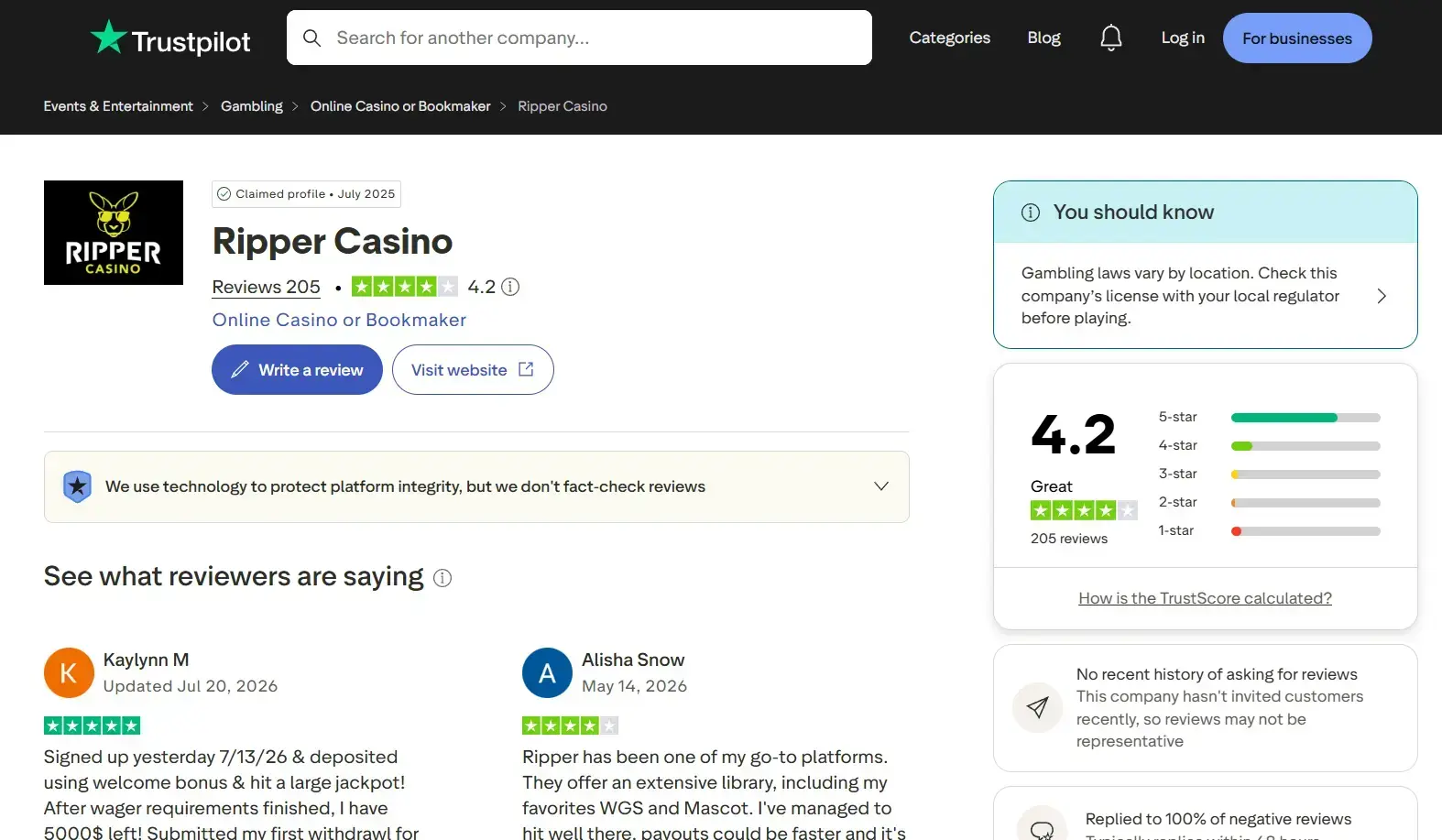
Current reputation snapshot
| Signal | Current checked position | What it can tell you | What it cannot prove |
|---|---|---|---|
| Trustpilot | 204 reviews, TrustScore 4.3/5; 72% five-star and 7% one-star as checked 9 September 2026 | Broad public sentiment and recurring experience themes | Guaranteed payout behaviour, fairness or regulatory status |
| Casino Guru complaints | 9 records: 0 open, 1 unresolved, 2 resolved, 6 rejected | Examples of disputes and how a complaint platform categorised their outcomes | The frequency of problems across the full player base |
| Ripper support pages | 24/7 live chat plus email support | Verified channels available for account questions | The quality or outcome of every individual support interaction |
| Ripper responsible-gaming page | Daily or monthly deposit limits and temporary or permanent self-exclusion are described | Operator-published control tools | Australian licensing or regulator endorsement |
| ACMA | Ripper Casino is named in ACMA’s 2023 prohibited-service investigation outcomes | Primary Australian regulatory context | The result of any individual player’s account dispute |
Start with an evidence hierarchy, not a star rating
Casino reputation pages often compress every signal into a single question such as “is Ripper Casino legit?” That question mixes separate issues. A public review score measures sentiment among people who chose to post a review. A complaint platform records selected disputes and applies its own handling rules. An operator page describes the service’s current channels and policies. A regulator records legal or enforcement facts within its jurisdiction.
Those sources should not be given equal weight. For Australian regulatory status, ACMA is stronger evidence than a five-star review or an affiliate rating. For whether Ripper currently advertises live chat or deposit-limit tools, the operator’s current support and responsible-gaming material is direct evidence. For how some users describe their experience, Trustpilot and complaint records are useful, but they remain subjective or case-specific.
This page therefore does not turn 204 reviews into a claim that Ripper is “safe”, “trusted” or “reliable”. It also does not treat a negative complaint as proof that every withdrawal will fail. The point is to identify patterns, then connect each pattern to the strongest factual page in this guide.
What the current Trustpilot profile shows
The current Trustpilot profile for Ripper Casino is a useful broad sentiment snapshot because it contains a relatively large and recent set of public reviews. As checked on 9 September 2026, the profile displayed 204 reviews, with 196 posted in the previous 12 months. The rating distribution was 72% five-star, 14% four-star, 4% three-star, 3% two-star and 7% one-star.
The positive examples visible in the current profile include users discussing game choice, successful withdrawals and helpful support. That is meaningful as evidence that some reviewers report satisfactory experiences. It is not evidence that the casino pays every customer on time, that a specific game outcome was fair, or that a future withdrawal will follow the same path.
The negative visible examples point to a different group of issues: bonus wagering confusion, support interactions that did not resolve a problem quickly, account verification questions and cashout frustration. These themes deserve attention because they overlap with areas where terms and account records matter. They still need to be read as individual accounts rather than independently audited findings.
Why review distribution matters more than the headline score
A 4.3 TrustScore looks simple, but the distribution gives more context. Most ratings are at the top end, while a smaller but non-trivial one-star group exists. That shape is more informative than saying the casino is either “good” or “bad” because it shows that experiences reported on the platform are not uniform.
It is also important to remember how review platforms work. People choose whether to post, the reviewer population is not a random sample of all customers, and the platform does not independently audit every underlying transaction described in a review. A high score can therefore support the statement that public sentiment on that platform is currently positive overall, but it cannot establish payout reliability as an objective rate.
For practical decisions, look for themes that can be checked elsewhere. A reviewer complaining about verification directs attention to the published KYC rules. A reviewer discussing a delayed withdrawal directs attention to method rules and account status. A reviewer praising a game catalogue is useful sentiment, while the actual game categories should still be verified on the operator’s current games material.
What the Casino Guru complaint record adds
The current Casino Guru Ripper Casino review adds a more structured complaint view. Its page currently lists nine complaint records: none open, one unresolved, two resolved and six rejected. The listed disputes include themes involving withdrawal difficulty, verification, bonus-related balance treatment, account closure and differences around crypto cashout amounts.
Those categories are useful because they show where disputes have arisen in submitted cases. The outcome labels need careful interpretation. A rejected complaint is not the same thing as a proven operator failure. A resolved complaint indicates that the complaint platform recorded a resolution, but it does not create a general service guarantee. The unresolved case is a warning signal for that individual dispute, not a statistical forecast for all players.
Casino Guru also publishes its own Safety Index and assessment methodology. That is a third-party editorial judgement, not a regulator decision. This guide uses its complaint records as reputation evidence but does not let that score override ACMA evidence or resolve conflicting offshore-licence reports.
The recurring complaint themes are decision-useful
- Withdrawals
- Cashout complaints are useful prompts to check current method rules, verification status and account terms before assuming a payout problem has one cause. The detailed mechanics belong in the Ripper withdrawals and cashout guide.
- Verification
- KYC-related complaints often involve an incomplete public record: the review describes the user’s side, while the operator account file is not visible. The verified evidence categories and what is not currently confirmed are covered in the Ripper verification guide.
- Bonus conditions
- Several public stories refer to wagering or bonus treatment. These should be checked against the current promotion terms rather than interpreted from the review alone.
- Support resolution
- Some reviews praise support while others describe long or unsatisfactory interactions. That disagreement is exactly why channel availability and service quality should be separated.
- Account status
- Complaints involving duplicate accounts, identity information or closure need the account terms as the factual baseline. Registration and account-record preparation are covered in the Ripper account and sign-up guide.
Verified support channels are clearer than support sentiment
Ripper’s current official material describes 24/7 live chat support and email support. That is a factual statement about available channels. It should not be expanded into a claim that support is always fast, always helpful or guaranteed to resolve a dispute in the player’s favour.
The mixed review record reinforces that distinction. Some reviewers describe helpful interactions, while others describe frustration or unresolved questions. Both can exist at the same time because channel availability is objective and interaction quality is experience-specific.
If an account issue matters financially, keep a record rather than relying only on a live conversation. Save the date and time, the issue raised, transaction references, any case number and the substance of the response. A clear chronology is more useful for later escalation than a memory of what was said.
Responsible-gaming tools are verified operator facts
Ripper’s current responsible-gaming page describes player-set daily or monthly deposit limits through support. It also describes self-exclusion for a week, a month, a year or permanently. These are stronger facts than a reviewer saying the casino does or does not encourage control, because the tools are described directly by the operator.
They still do not answer the Australian regulatory question. Operator-provided deposit controls and self-exclusion are account-level tools and should be assessed on their own terms.
For a user who is uncomfortable with spending or play, the reputation score is not the relevant decision tool. Using limits, self-exclusion or independent gambling-help resources is more important than comparing star ratings.
ACMA evidence changes how Australian readers should interpret reputation
The strongest Australian-specific reputation fact is regulatory rather than anecdotal. ACMA’s online gambling investigation outcomes name Ripper Casino in the 2023 prohibited-services list and state that the listed services provided a prohibited interactive gambling service with an Australian customer link.
That record cannot be cancelled out by a high Trustpilot score. Equally, it does not prove the facts alleged in every negative player review. These are different evidence layers. ACMA addresses Australian regulatory conduct; review platforms capture customer sentiment and dispute stories.
The current Australian licensed interactive wagering register contains a separate service named Ripper Bet, not Ripper Casino. The two should not be conflated. The full legal and register analysis, including why operational access is different from Australian authorisation, is kept on the Ripper Casino legal status in Australia page.
How to read a withdrawal or KYC complaint
A useful complaint review asks what is known and what is missing. Start with the date, transaction or withdrawal method, bonus status, verification stage and whether the complaint includes the operator response. A story that omits those details can still describe a genuine frustration, but it is harder to use as evidence for a broader conclusion.
Next, separate a delay from a refusal, a verification request from a completed verification, and a bonus dispute from a cash-balance dispute. These distinctions matter because they point to different rules. A headline such as “casino did not pay” can hide several materially different scenarios.
Finally, check whether the complaint platform recorded a resolution, rejection or unresolved status. That classification does not tell the whole story, but it is better than quoting only the most dramatic sentence from the user. This is why the Casino Guru record is useful alongside Trustpilot rather than as a replacement for it.
A practical reputation checklist
- Use dated review snapshots. Scores and review counts change, so record when the profile was checked.
- Read both ends of the distribution. Positive and negative reviews reveal different friction points.
- Do not convert anecdotes into payout statistics. Public reviews do not show the denominator of all transactions.
- Check structured complaints. Look at resolution status and dispute category, not only the complaint headline.
- Verify operational facts separately. Support channels, KYC rules and responsible-gaming tools should come from current operator material.
- Verify legal facts with the regulator. ACMA evidence has a different and stronger role for Australian regulatory questions.
- Keep your own records. Saved account records, timestamps, transaction references and support messages are useful if an account issue develops.
- Avoid absolute labels. “Safe”, “scam”, “trusted” and “guaranteed payout” are stronger conclusions than the available evidence supports.
Bottom line
Ripper Casino’s current public reputation is mixed in a way that a single rating cannot capture. Trustpilot sentiment is positive overall, with 204 reviews and a 4.3 TrustScore at the 9 September 2026 check, but the profile also contains negative accounts around support, bonuses, KYC and withdrawals. Casino Guru adds a smaller structured set of complaint cases, including one currently unresolved record, while also showing resolved and rejected cases.
For an Australian reader, those reputation signals should sit below primary evidence. Ripper has support and responsible-gaming channels, while ACMA has also specifically named Ripper Casino in enforcement history. The sensible reading is neither “reviews prove it is reliable” nor “one complaint proves every account will fail”. Use reviews to identify questions, then use current terms, account records and regulator evidence to answer them.
For the broader brand assessment, return to the Ripper Casino Australia review.