
Ripper KYC at a glance
| Verification question | Current verified answer | What this guide does not claim |
|---|---|---|
| Is verification required for withdrawals? | Yes. | No claim that every withdrawal is reviewed in exactly the same way. |
| What evidence categories are confirmed? | Identity, address and payment-method details. | No expanded document list beyond the currently reconfirmed categories. |
| Can source-of-funds or wealth evidence be requested? | Yes, the current terms say it may be requested. | No invented universal trigger or threshold. |
| Is an exact KYC processing time verified? | No. | No “instant”, “same-day” or fixed-hours promise. |
| Does verification guarantee a withdrawal? | No. | KYC is one part of the process; payment and bonus conditions can still apply. |
The three verified evidence categories
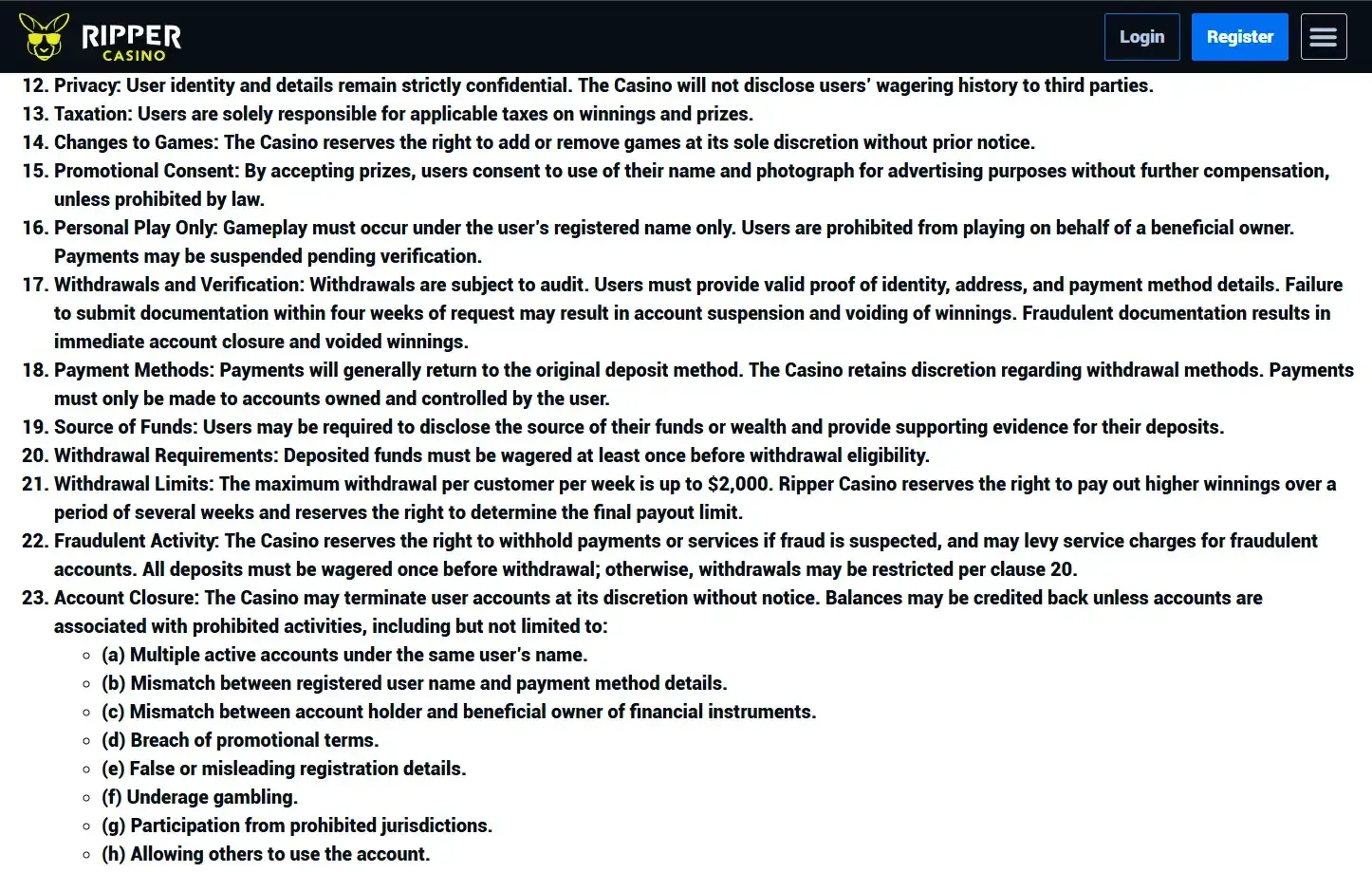
The current terms give a clear category-level framework. They require valid proof connected to identity, address and payment-method details. Those categories answer different questions, so treating them as interchangeable can make a verification submission harder to understand.
| Category | Purpose in the account record | Preparation principle |
|---|---|---|
| Identity | Connect the account to the person using it. | Make sure the identity information agrees with the account record. |
| Address | Support the residential details associated with the account. | Use current information that matches the address registered with the account where required. |
| Payment-method details | Connect deposits or withdrawals to a method associated with the account holder. | Keep ownership and transaction records consistent with the account identity. |
This guide does not reproduce a longer document list because the current primary terms confirm only the three categories above. Specific document requests can vary, so readers should follow the current verification instructions shown for their account rather than rely on older examples.
Verification is linked directly to withdrawals
Ripper’s current terms make withdrawals subject to verification. That means KYC should be treated as part of the cashout path, not as a background profile feature that can always be deferred. A user can have a functioning account and still need to complete verification before a withdrawal is processed.
The useful planning step is to review the account information before requesting a cashout. Identity, address and payment-method records should tell the same story. If they do not, it is better to address the inconsistency through the current support route than to assume the withdrawal process will ignore it.
For method-level cashout information, limits and the currently verified payout routes, use the Ripper withdrawals guide. This verification page does not duplicate the banking table because KYC and payment-method availability are related but different questions.
Why identity consistency matters
A verification process compares evidence with the account record. That makes accurate registration details important long before a withdrawal request. A mismatch between the person named on the account and the evidence later supplied can create a question that would not exist if the record had been consistent from the beginning.
This is also why the broader Ripper sign-up and account guide treats registration and verification as one information chain. The account is the initial record. KYC is the supporting evidence layer. Neither stage should be built around nicknames, borrowed identities or improvised details.
The page does not prescribe a specific correction process because the current public interface may change and no current public source defines exactly how account data amendments are handled. If a material detail is wrong, current support is the appropriate place to clarify the account rather than guessing at an interface sequence.
Address evidence is a separate category
Proof of address is not simply another version of identity evidence. Its purpose is to support the residential information attached to the account. That is why a verification checklist should keep “who is this person?” and “what address is attached to this account?” as separate questions.
The current terms confirm proof of address as a category, but this page does not publish a fixed list of accepted address documents. Evidence requirements can change, so the safer approach is to describe the confirmed category rather than fill the gap with common KYC examples.
Users preparing for verification should therefore follow the evidence request actually shown or communicated for their account. The important principle is that the address evidence should correspond to the same account record being verified.
Payment-method evidence connects KYC to banking
The current terms also require payment-method details as part of the withdrawal verification framework. That creates a direct connection between the identity on the account and the routes used to move money. A payment method should not be treated as unrelated to KYC merely because it was accepted at the deposit stage.
The most practical preparation is to use payment methods under the account holder’s control and keep records showing the relevant transaction history. This does not mean every user will receive the same evidence request. It means the verified policy allows payment details to form part of the account review.
If a payment method has changed, expired or is no longer accessible, keep the underlying transaction records and ask support how the current account should be handled. This page does not invent a replacement-method procedure.
Source-of-funds or wealth checks can appear
Ripper’s current terms state that users may be required to disclose the source of funds or wealth and provide supporting evidence for deposits. This is a different concept from basic identity or address verification. It is concerned with the origin of money connected to the account.
The terms do not specify one universal trigger, amount or timing point that automatically produces such a request. This guide therefore does not claim that a particular deposit size, number of transactions or withdrawal amount will trigger a source-of-funds check.
If such a request is made, the relevant response is to follow the account-specific instruction and provide evidence that actually supports the stated source. Guessing at likely triggers or preparing unrelated documents does not improve the quality of the account record.
No exact KYC processing time is verified
No current official source confirms a fixed KYC processing time. That means a precise statement such as “verification takes 24 hours” would not be supported, even if another review site publishes a number.
This is an important distinction because verification time is a residual high-risk fact. It can change, depend on the account and be described differently across support or review sources. Without current primary evidence, the correct public wording is simply that verification is required for withdrawals and that no exact processing time is verified here.
Users should therefore avoid planning a time-sensitive cashout around an assumed KYC turnaround. Treat verification as a prerequisite that can require account review rather than a guaranteed fixed-duration task.
What a clean verification record looks like
- Consistent identity
- The person named on the account and the identity evidence refer to the same account holder.
- Consistent address
- The account’s residential information can be supported by the address evidence requested for the review.
- Controlled payment method
- The account holder can support the payment details connected to deposits or withdrawals where requested.
- Documented transaction history
- Relevant deposits, withdrawals and support messages are retained so that account questions can be reconstructed accurately.
- No invented timing assumption
- The user does not treat an unverified third-party KYC estimate as a guaranteed operator timeframe.
Verification answers an account question
KYC is an operator account control. Completing it answers an identity-and-account requirement, not every other question about using the service.
For Australian legal context, read the Ripper Casino legal status in Australia page. This guide stays focused on what the current verification process requires.
The same separation applies in the other direction: a regulatory concern does not change the factual description of what the current terms require for account verification. Each claim is handled on its own evidence.
How to read KYC complaints and review stories
Public complaints about verification can be useful signals, but they do not provide the complete account file. A review may describe a request for documents, a delay or a disputed withdrawal without showing the full registration, payment and support history.
The strongest way to interpret a complaint is to compare it with the primary rules first. Ripper does require withdrawal verification, and the current terms do allow identity, address, payment-method and source-of-funds evidence. A complaint about one of those categories is therefore not evidence that the category itself was invented. It can still raise questions about how the process was handled in that individual case.
For a broader assessment of complaint themes, positive reviews and public reputation signals, use the Ripper Casino reviews page. This KYC guide stays focused on what the current verification policy can actually support.
Verification checklist before a withdrawal
- Review the account identity. Make sure the personal details attached to the account are accurate.
- Review the account address. Be ready to support the residential details if address evidence is requested.
- Review payment ownership. Keep records for the deposit or withdrawal methods connected to the account.
- Expect verification before cashout. Ripper currently requires verification for withdrawals.
- Follow the current evidence request. Do not assume an old review’s document list is the same as the evidence being requested now.
- Be prepared for source-of-funds questions. The current terms allow such requests but do not state a universal trigger.
- Do not rely on a fixed KYC time estimate. No exact current processing time is confirmed by current official sources.
- Keep a record of the review. Save submission dates, account messages and support references so that a later issue can be described accurately.
Bottom line
Ripper’s verification framework is clear at the category level: withdrawals require verification, and the current terms support identity, address and payment-method evidence. They also allow source-of-funds or wealth evidence to be requested. What is not verified is an exact universal KYC processing time or a fixed additional-document list for every account.
The best preparation is therefore consistency rather than guesswork. Keep the registration record accurate, use payment methods tied to the account holder, retain transaction evidence and respond to the current account-specific verification request. That approach stays within the facts that can be supported now and avoids treating common KYC assumptions as Ripper-specific rules.
For the broader brand assessment, return to the Ripper Casino Australia review.