
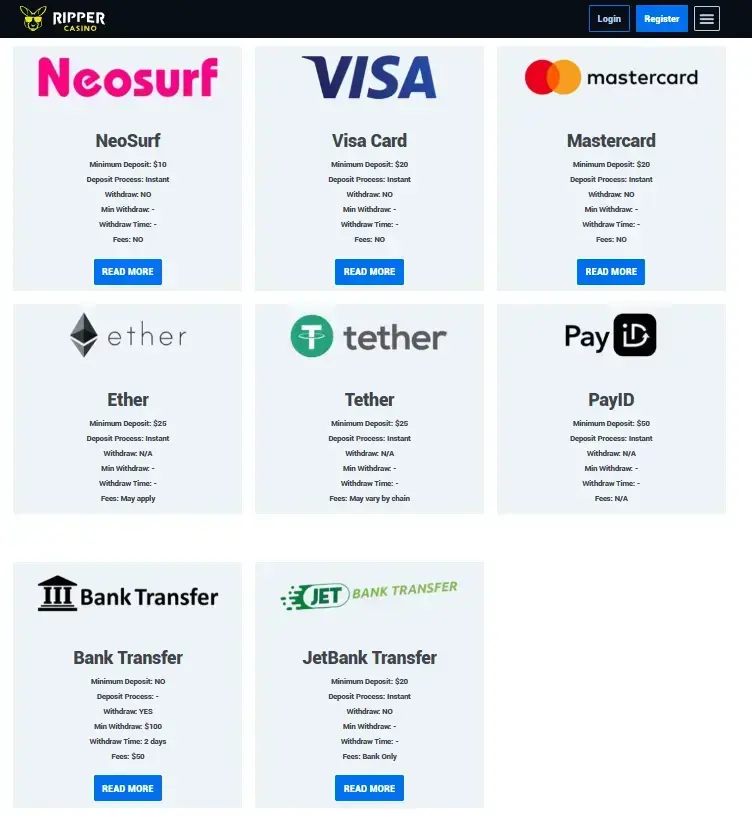
Ripper payment methods at a glance
| Payment group | Current verified role at Ripper | Australian context | Main practical question |
|---|---|---|---|
| PayID | Deposit option | Widely known and used account-to-account rail in Australia | Is the PayID option visible in the cashier for your account? |
| Visa and Mastercard | Deposit options | Cards remain the most widely used consumer payment method in Australia | Does your issuer allow the transaction? |
| Neosurf and CashToCode | Deposit options | Prepaid or voucher-style funding | Do you want to separate casino funding from a primary card or bank rail? |
| eZeeWallet | Deposit and withdrawal option | Wallet route rather than direct card funding | Can the same wallet receive your eventual withdrawal? |
| JetBank | Deposit option | Bank-based deposit rail | Is it available in your current cashier session? |
| Bitcoin and other crypto | Several crypto deposit options; Bitcoin also listed for withdrawals | Crypto payments remain niche in Australian consumer payment data | Are you prepared for network and asset-value considerations? |
| Bank transfer | Withdrawal route on the current banking page | Traditional account-to-account cashout route | What current fee, limit and processing conditions apply? |
The key distinction: deposit rails are not withdrawal rails
The most important banking check is directional. Ripper’s current official banking page lists many ways to deposit, but only a smaller set is marked for withdrawals. That means it is unsafe to assume that Visa, Mastercard, PayID, Neosurf, CashToCode, Litecoin or every other deposit method will also be available for cashout. The verified withdrawal set on the current page is Bitcoin, eZeeWallet and bank transfer.
The current banking page should therefore be read as a directional method list rather than a promise that every account will see every route in the same way. Ripper requires account verification for withdrawals, so the payment stage and the verification stage should be planned together rather than treated as unrelated tasks.
For that reason, this guide treats the cashier as a two-stage system. First, choose a funding method that you can use and document. Second, before depositing a meaningful amount, inspect the withdrawal choices and current terms. A deposit route that is convenient today can still create friction later if the eventual cashout path is different or requires additional verification.
Why PayID is relevant to Australian users
PayID deserves separate attention because it is not just another global payment brand. It is an Australian payments service that lets users address payments with details such as a mobile number, email address or ABN rather than manually entering BSB and account-number details. The Reserve Bank of Australia’s 2025 Consumer Payments Survey found that around 80% of respondents were aware of PayID and around 50% had used it in the previous year, up from 32% in 2022.
That makes PayID a familiar rail for many Australian consumers, and Ripper currently lists it as a deposit option. The connection ends there. RBA adoption data says nothing about whether an individual Australian bank will approve a transaction to a particular online gambling service. Treat PayID here as a payment option, not as a broader endorsement signal.
The practical PayID check is therefore narrow: confirm the method appears in the live cashier, confirm the recipient details shown at the time of payment, and keep a record of the transaction. Do not interpret the presence of PayID as a guarantee of instant crediting or as evidence that every Australian bank treats the transaction the same way.
For Australian legal context, use the Ripper Casino legal status in Australia guide rather than trying to infer broader conclusions from a payment logo.
Cards remain familiar, but issuer approval is a separate layer
Cards remain the most widely used consumer payment method in Australia. The RBA’s 2025 survey found that cards were used for most consumer payments and remained dominant across a wide range of transaction types. Ripper’s current banking page lists both Visa and Mastercard as deposit methods, so card funding sits at the intersection of a familiar Australian habit and the casino’s current cashier menu.
However, a logo in a cashier does not guarantee that a specific card transaction will be accepted. Card issuers apply their own merchant, risk and gambling transaction rules. The correct conclusion is simply that Ripper currently lists Visa and Mastercard for deposits. It is not safe to say that all Australian debit cards, credit cards or banks permit the transaction.
A useful practical test is to separate three questions: whether Ripper lists the method, whether your issuer permits the transaction, and whether the method is useful for withdrawals. The first is verified here. The second depends on the issuer. The third should be checked against the current cashier and the dedicated cashout guidance on this site.
Vouchers and e-wallets solve different problems
Ripper currently lists Neosurf and CashToCode among its deposit options. These are useful to think about as budgeting and funding-separation tools rather than as direct substitutes for a bank withdrawal route. A prepaid or voucher-style method can limit the amount loaded through that instrument, but it does not remove the need for account verification or create a matching withdrawal channel.
eZeeWallet has a different role because the current banking page marks it for both deposits and withdrawals. That makes it one of the few verified methods with a role on both sides of the cashier. Even then, the safest workflow is to verify the live cashout choices before relying on a particular route and to remember that Ripper requires verification for withdrawals.
Readers comparing these options in detail should use the dedicated deposit options page, where the methods are compared by practical use case without duplicating the whole banking overview.
Crypto is available, but it is not the default Australian payment habit
Ripper’s verified deposit set includes Bitcoin, Bitcoin Cash, Lightning Bitcoin, Litecoin, Ether and Tether. Bitcoin is also listed as a withdrawal route on the current banking page. This gives crypto a real place in the cashier architecture, but Australian consumer payment data puts that option in perspective. In the RBA’s 2025 survey, only around 2% of respondents reported using cryptocurrency to make a payment in the previous year.
That contrast is useful. Crypto support at Ripper is a brand-specific feature, while crypto remains a niche payment behaviour in Australia compared with cards and PayID. A user considering crypto should therefore evaluate it on its own operational characteristics, not because it is a standard Australian casino banking route.
Crypto also does not bypass verification requirements or the Australian legal framework. Ripper requires account verification for withdrawals, and crypto support does not change that requirement. This guide also avoids turning any cashier speed label into a guaranteed end-to-end outcome.
Withdrawals: what this overview verifies and what it leaves to the cashout page
The current official banking page marks Bitcoin, eZeeWallet and bank transfer as withdrawal routes. Ripper also requires account verification for withdrawals. Those verified facts are enough to explain the structure of the process without importing unsupported assumptions about every account or method.
Exact weekly limits, method-specific fees and processing times are more sensitive to change. They are intentionally not frozen into this overview even though the current official pages publish values. The dedicated withdrawal limits and payout times guide is where those current values and the verification layer are covered in more detail.
Verification is particularly important because a payment method is only one part of a withdrawal. Verification can become part of the cashout process even when the deposit itself was straightforward. Before requesting a withdrawal, review the Ripper verification guide and make sure your account information and payment records are consistent.
A practical banking workflow before you deposit
- Check the live cashier. Payment menus change, so confirm that the method you want is actually visible for your account.
- Separate deposit and withdrawal availability. Do not assume a deposit method will receive a cashout.
- Keep account details consistent. Avoid introducing unnecessary discrepancies between the information used during registration and later verification.
- Read current withdrawal conditions. Limits, fees and stated processing times can change and belong in a same-day check.
- Keep transaction records. Save receipts, reference numbers and relevant cashier records in case a payment needs to be traced.
- Prepare for verification. Account checks can be part of the withdrawal process even when the deposit itself was straightforward.
If you have not created an account yet, the Ripper sign-up and account guide explains the account structure without assuming that payment availability equals Australian regulatory approval.
Payment availability does not establish Australian authorisation
It is important not to treat a familiar payment rail as an endorsement or consumer-protection signal. PayID availability is a banking fact; broader legal context is covered separately in the legal-status guide.
This separation prevents a common review-site error: using convenient payments as shorthand for overall trust. Payment compatibility answers how money can move; broader legal and consumer-protection context is covered separately.
What a payment table cannot tell you
A cashier table is a snapshot of offered rails, not a complete prediction of a transaction. It cannot tell you whether your bank will decline a merchant, whether an account-level verification request will appear, whether a network will be congested, or whether a payment option will still be offered after account details change. That is why this guide separates method availability from outcome guarantees.
The safest interpretation of the current evidence is narrow: Ripper lists the named methods today, and the RBA data explains how common some of those rails are in Australia. Neither source supports a universal claim about approval, settlement speed or future availability. Treat every operational value as something to reconfirm at the point of use.
Bottom line
Ripper Casino currently offers a broad deposit menu that includes PayID, cards, vouchers, an e-wallet, bank-style funding and multiple cryptocurrencies. Its verified withdrawal list is narrower, with Bitcoin, eZeeWallet and bank transfer currently identified as cashout routes. For Australians, PayID and cards are familiar mainstream payment tools, while crypto remains comparatively niche in national consumer-payment data.
The best way to use that information is not to chase the longest method list. Check the direction of each rail, verify the live cashier, keep payment ownership consistent, and treat exact fees, limits and processing times as current-session facts. For the site-wide assessment, return to the full Ripper Casino review.